A 32-year-old female patient presented with non-healing wounds in the perineal region of more than two years' duration, diagnosed elsewhere as fistula-in-ano and operated upon multiple times by several surgeons without benefit, with recurrence following every procedure. Detailed history-taking revealed two significant points: an episiotomy performed four years earlier, and perineal wounds that discharged excessive, and notably bloody, fluid during and after menstruation. Local examination revealed a badly scarred area with multiple external and internal openings overlying a deep-seated, hard swelling in the perianal region extending from the 10 to 12 o'clock position. The combination of cyclical (menstrual) exacerbation of haemorrhagic discharge and a prior history of episiotomy clinched the diagnosis of scar endometriosis with blood-discharging sinuses mimicking fistula-in-ano. Wide and complete excision of the swelling, together with the fistulous tracts, was performed, followed by routine dressings; no hormonal therapy was administered. Naked-eye examination of the excised specimen and subsequent histopathological reporting confirmed the diagnosis of endometriosis. The wound healed uneventfully within four weeks, with no recurrence over a follow-up period of three years. Episiotomy scar endometriosis presenting as a nodular mass has been reported previously in the literature, but not, to the best of our knowledge, as a lesion mimicking fistula-in-ano. This may represent the first reported case of its kind.
A 32-year-old female patient presented with complaints of non-healing wounds in the perineal region persisting for more than two years. She had been diagnosed with fistula-in-ano by several surgeons and had undergone multiple operations for the same, without any lasting benefit — the lesion recurred after every procedure.
On eliciting a detailed history from the patient, two important points emerged: a history of episiotomy four years earlier, and a history of perineal wounds that showed excessive discharge, notably bloody, during and after menstruation.
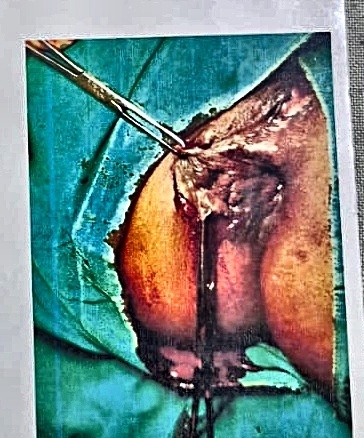
On local examination, there was a very poor scar with multiple openings, both on the surface and inside the anus, overlying a deep-seated hard swelling in the perianal region extending from the 10 to 12 o'clock position (Picture 1). These two points — the history of cyclical exacerbation of haemorrhagic discharge coinciding with menstruation, and the past history of episiotomy — clinched the diagnosis of scar endometriosis with blood-discharging sinuses mimicking fistula-in-ano.
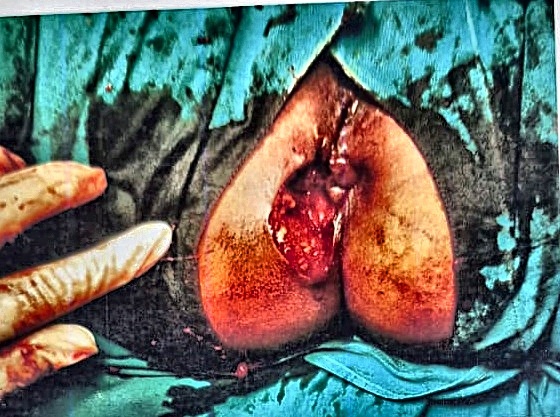
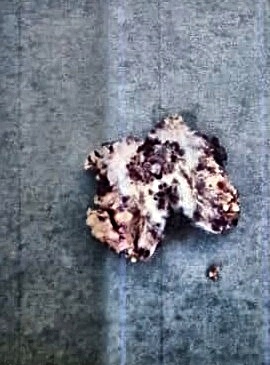
Wide and complete excision of the swelling, including all fistulous tracts, was carried out (Picture 2), followed by routine dressings. No hormone therapy was administered. This regimen resulted in complete cure of the patient. Naked-eye examination of the specimen (Picture 3), together with histopathological examination, confirmed the diagnosis of endometriosis.
Following excision of the lesion, the wound healed uneventfully within four weeks. The patient has shown no recurrence even after a follow-up period of three years.
Episiotomy scar endometriosis presenting as a nodular mass has been described in the literature on several occasions,(1,2,4) including one report with anal sphincter involvement.(3) However, to the best of our knowledge, presentation as a lesion with multiple external and internal openings clinically mimicking fistula-in-ano has not been previously described. This is therefore likely to be the first reported case of its kind.
The best treatment for scar endometriosis remains complete surgical excision. Hormonal therapy — using agents such as progesterone, oral contraceptive pills, and danazol — has been used in the past, but provides only symptomatic and palliative relief rather than cure.
A high index of suspicion for scar endometriosis should be maintained in any patient with a non-healing perineal or perianal wound and a history of episiotomy or other perineal surgery, particularly when the discharge shows cyclical, menstruation-related exacerbation. Complete surgical excision offers a durable cure, obviating the need for repeated, unsuccessful fistula surgery.
Conflict of Interest
No conflict of interest.
Funding
No funding was received for this work.
- Jeyaseelan S, Kwatra N. A rare case of episiotomy scar endometriosis. J Obstet Gynaecol India. 2016 Oct;66(Suppl 2):654-655.
- Dadhwal V, Sharma A, Khoiwal K, Nakra T. A case of endometriosis in episiotomy scar. Med J Armed Forces India. 2018;74(3):297-298.
- Guana BRD, Rodriguez D, Cabre S, Calleza. A case of endometriosis in episiotomy scar with anal sphincter involvement. Int J Clin Med. 2011;2:624-625.
- Sharma N, Khan DA, Jethani R, Barvah S, Dey B. Perineal endometriosis in an episiotomy scar: A case report. Gynaecol Obstet. 4(2):66.
Professor of Surgery, Ex-HOD, SMS Medical College, Jaipur, and RNT Medical College, Udaipur
Medical Director & Chief Surgeon, Malpani Multispeciality Hospital & Piles and Varicose Veins Laser Therapy Centre, Jaipur Hospital Road No. 1, Vishwakarma Industrial Area, Sikar Road, Jaipur, Rajasthan, India · 0141-4020948 Mobile 94141-69090 Peer Reviewer Dr. Kailash Chand Kuradia, Assistant Professor, GI Surgery & Liver Transplantation, AIIMS Delhi — reviewed and cleared for publication