Necessity, Not Infrastructure: A Founding Editorial on the Origins of Innovation Across Science, Medicine and Engineering
Founding Editor, Global Science Portal for Surgical, Procedural and Clinical Innovations
Founder General Secretary, Global Scientist Forum (established 2000)
Consultant Surgeon and Director, Dr. Bhandari Piles Hospital, Chittorgarh, Rajasthan, India
Correspondence: opbhandari@hotmail.com · +91-9414109124
This journal opens with a deliberate choice of subject — not a statement of scope, but a single story that contains, in miniature, the entire argument this journal exists to make.
This journal opens with a deliberate choice of subject. We could have begun, as many journals do, with a statement of scope: the specialities we will cover, the standards we will hold, the kind of work we hope to receive. We will come to all of that. But a founding editorial earns its place only if it says something the editor actually believes, and so we begin instead with a single story — one small, almost forgotten paper, written in 1978 by a postgraduate surgical student in a government hospital in Udaipur, Rajasthan — because that story contains, in miniature, the entire argument this journal exists to make.
I. A Tetanus Ward, 1977
In 1977–78, no peripheral intravenous cannula existed in government hospitals across Rajasthan. The only available instrument for intravenous access was a rigid steel needle, and the patients who depended most desperately on sustained intravenous therapy — those admitted with tetanus, unable to swallow, convulsing violently and unpredictably — were precisely the patients in whom a rigid needle could not survive. Every convulsion jerked the limb. Within three or four days, the vein had thrombosed, the surrounding tissue had swollen with extravasated fluid, and another access site was lost. Patients exhausted their veins faster than their tetanus could resolve. Many died not of the toxin directly, but of the failure of the only treatment that could keep them alive long enough to recover from it.
A young postgraduate student named O. P. Bhandari, assigned to the tetanus ward of the Fourth Unit of Surgery at Ravindra Nath Tagore Medical College and Hospital, faced this problem daily. He did not have access to a scalp vein set or an over-the-needle cannula — these devices were still years from reaching that hospital’s supply chain. What he had was a blood transfusion set needle, with a bore wide enough to accommodate the plastic tubing used in venesection kits. He reasoned that the needle could be used not as the permanent indwelling device, but as a temporary introducer: thread the tubing through it, puncture the vein, advance the tubing, then withdraw the needle and leave the flexible tube behind.
This is the over-the-needle principle that underlies every peripheral IV cannula used in hospitals today. Sven-Ivar Seldinger had described the related guide-wire technique for arterial access in 1953. Dr. Bhandari had not read Seldinger’s paper, and would not encounter it for decades. He derived the same functional insight independently, twenty-four years later, from a blood transfusion needle and a length of venesection tubing, because a ward full of dying patients gave him no other option. The technique was documented and published in 1978–79, co-authored with Dr. P. Bajaj, Dr. S. R. Somani, and Dr. Y. C. Vora, under the modest title ‘A Simple Method of Percutaneous Cannulation of Vein for Continuous Infusion.’ It became Work No. 1 of a research career that would eventually span more than four and a half decades.
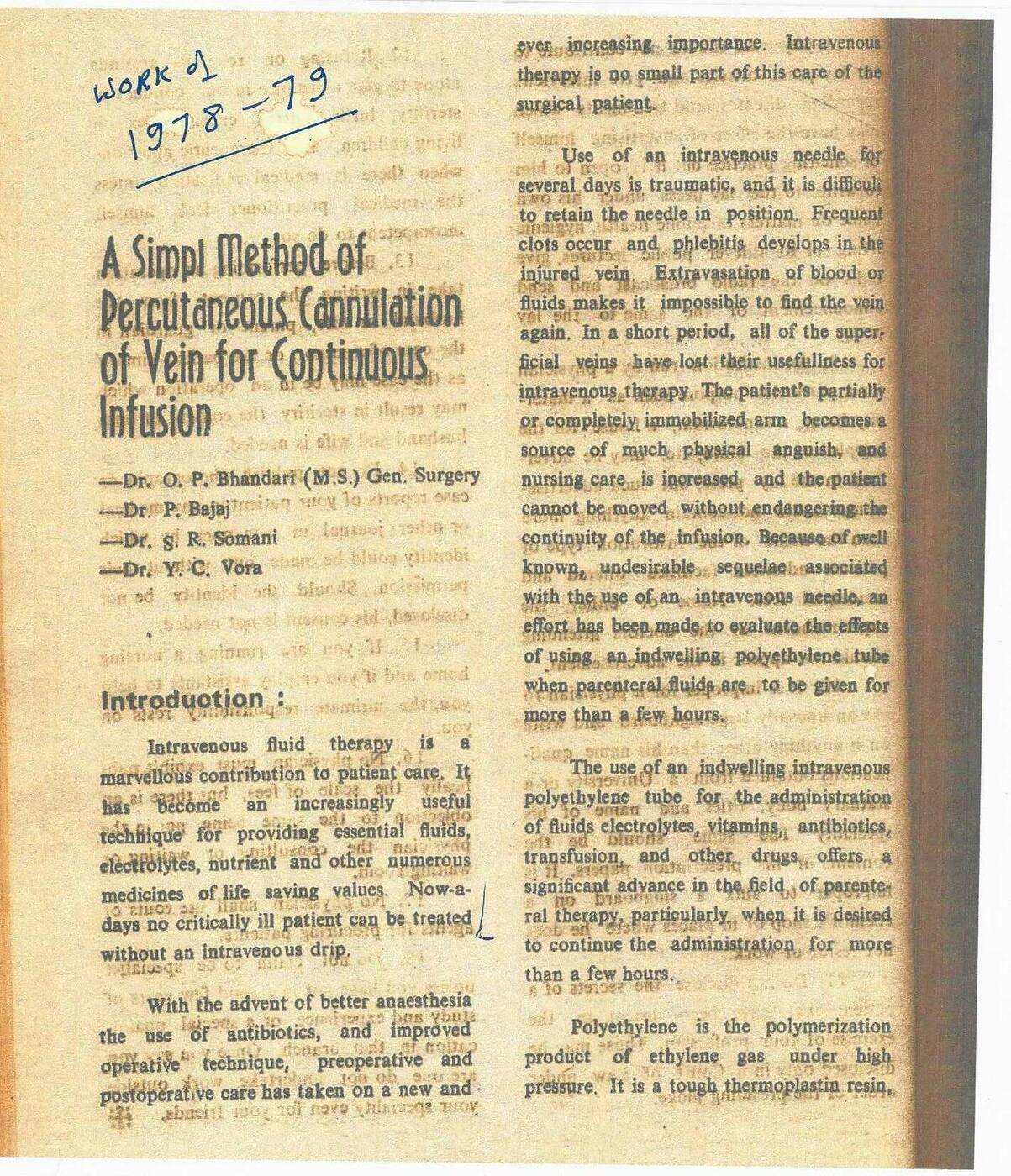
Fig. 1. Original scanned page of ‘A Simple Method of Percutaneous Cannulation of Vein for Continuous Infusion,’ published 1978–79, bearing the author’s handwritten annotation ‘Work 1 / 1978–79.’ Reproduced from the author’s personal archive.
The original journal page survives in the author’s personal archive, annotated by hand: ‘Work 1, 1978–79.’ We reproduce it here, not as a museum piece, but as evidence — the kind of evidence every working scientist and engineer will recognise on sight, because most of us have a version of this page somewhere in a drawer.
II. Why This Story Opens a Multidisciplinary Journal
It would be easy to read the story above as a piece of surgical history and nothing more. We ask the reader — surgeon, physician, engineer, chemist, agricultural scientist, computer scientist, whatever your discipline — to read it instead as a description of a process you have lived through yourself, in your own field, under your own constraints.
Every working technocrat knows this sequence: a problem that the available tools cannot solve, a period of dissatisfaction with the standard answer, the noticing of an unrelated object or method that might be repurposed, and then the unglamorous work of testing whether the repurposing actually holds up. An engineer staring at a failed component improvises a fix from materials at hand and later discovers, reading the literature years afterward, that a formal version of the same principle already existed in a different field. A field biologist solves a measurement problem with a method borrowed from an entirely unrelated discipline. A software engineer, blocked by a constraint nobody had previously documented, arrives independently at a solution that a theoretical computer scientist had proven decades earlier. None of these moments require a well-funded laboratory. All of them require a precise understanding of what is failing, and the discipline to reason from that failure toward a solution rather than simply working around it.
“The postgraduate student in a district tetanus ward and the funded researcher in a metropolitan laboratory are engaged, at bottom, in the same activity.”
This is the founding premise of the Global Scientist Forum, established in the year 2000 as a common platform for engineers, doctors, scientists, and technologists of every description. The Forum was built on the conviction that innovation is not the exclusive property of any one discipline, any one institution, or any one level of infrastructure — that the postgraduate student in a district tetanus ward and the funded researcher in a metropolitan laboratory are engaged, at bottom, in the same activity, and that the surgical literature, the engineering literature, and the broader scientific literature have far more to say to one another than disciplinary silos usually permit.
The Global Science Portal for Surgical, Procedural and Clinical Innovations exists as one expression of that conviction, with a deliberate emphasis on surgical and procedural technique — but its editorial sympathies, and its intended readership, extend to every technocrat who has ever solved a problem with what was on hand rather than what was on the requisition form.
III. What We Mean by Innovation
There is a tendency, in both the popular and the academic imagination, to locate innovation in well-resourced settings: the funded research programme, the industry partnership, the university department with its instrumentation and its graduate students. This is not wrong — a great deal of essential work does come from exactly these settings, and this journal will publish it gladly. But it is an incomplete account of how technical knowledge actually grows.
The operating theatres of district hospitals, the workshops of small engineering firms, the field stations of agricultural researchers, and the improvised laboratories of clinicians working without specialist equipment see a volume and variety of problems that better-resourced settings often do not encounter at all. The practitioners in these settings frequently develop modifications, adaptations, and original solutions that never reach a journal — not because the work lacks merit, but because the practitioner does not have the time to write, does not know the pathway to publication, or simply believes, as many genuinely skilled professionals do, that what they have done is merely ordinary problem-solving rather than a contribution worth recording.
It is not ordinary. The 1978 tetanus-ward cannulation is one instance of a pattern that is surely repeating itself, in some form, in hundreds of operating theatres, workshops, and field stations across the world at this moment. The obligation of journals, professional societies, and academic institutions is to create the conditions under which such contributions can be documented, evaluated, and transmitted — before the practitioner retires, before the notebook is lost, before the only surviving record is a handwritten annotation on a yellowing page.
IV. The Scope of This Journal, and an Invitation
The Global Science Portal for Surgical, Procedural and Clinical Innovations is an open-access, peer-reviewed journal publishing original research, case reports, technical notes, historical perspectives, and operative reviews across medicine, surgery, and the allied clinical specialities. Our particular interest is in procedural innovation: novel techniques, principled modifications of established operations, and instructive case material — especially material documented with operative video, clinical photography, or other primary evidence that allows the reader to see, not merely read about, what was done.
We extend a direct invitation to readers and prospective authors well beyond clinical medicine. If you are an engineer who solved a fabrication problem with a method nobody had written down; a chemist who found that a technique developed for one application transferred, unexpectedly, to another; a computer scientist who arrived independently at a result that a formal proof would later vindicate; or any technocrat, in any branch of science or technology, who has a documented instance of necessity producing invention — we want to hear from you, and we will work with you, as we have worked with the case material in this issue, to bring that work to a publishable standard.
This is not a lowering of editorial rigour. It is a widening of editorial attention. The standards of evidence, documentation, and honest reporting that govern a surgical case report apply equally to an engineering case study or a field-science technical note, and we will hold all submissions to them.
V. Conclusion
In 1977, a postgraduate student in a tetanus ward had no cannula, no scalp vein set, and no time to wait for one to arrive. He had a blood transfusion needle, a length of plastic tubing, and patients who would die without a solution. He built the solution. He wrote it down. Forty-seven years later, the handwritten note on that yellowing page — ‘Work 1, 1978–79’ — is the first exhibit in the case this journal intends to make, issue after issue: that necessity, honestly confronted and carefully documented, remains the most reliable engine of innovation that science and engineering possess, regardless of the discipline in which it is found or the infrastructure available to the person who finds it.
We invite you to read the historical perspective article that follows, which documents this innovation in full technical and historical detail. And we invite every reader of this journal — surgeon or engineer, physician or physicist, technocrat of any description — to consider whether your own drawer holds a page like this one, still waiting to be written down.
Declarations
- Nature of Article
- This is an editorial accompanying the inaugural issue of the journal. It expresses the editorial perspective of the Founding Editor and is offered as context for the historical perspective article published alongside it.
- Conflict of Interest
- The author declares no conflict of interest.
- Funding
- No funding was received for this work.
- Use of Archival Material
- This editorial reproduces one figure: a photograph of the original 1978–79 published page, retained in the author’s personal archive. The author confirms ownership and consent to its reproduction.