When the Little Finger Won’t Pass
Bilateral OPB–MOLIS as a Solution to Severe Anal Canal Stenosis — The Rabiya Case
Director and Consultant Surgeon, Dr. Bhandari Piles Hospital, Chittorgarh, Rajasthan, India
Honorary Consultant, M.P. Birla Hospital and Research Centre, Chittorgarh, Rajasthan, India
Life Member, ASI (No. 4020) · Founder Life Member, ACRSI (No. 37) · ORCID: 0009-0008-3982-0950
Date of Procedure: 14 June 2026 · Correspondence: opbhandari@hotmail.com · +91-9414109124
Abstract
Background: Severe anal canal stenosis is a challenging surgical condition that may result from prior anal surgery, chronic fissure, or inflammatory disease. Classical management with unilateral lateral internal sphincterotomy is often insufficient in severe cases. We report the second case of bilateral OPB–MOLIS — a novel technique of Modified Open Lateral Internal Sphincterotomy dividing the lower one-third of the internal anal sphincter bilaterally — performed for severe anal canal stenosis.
Case Presentation: A 78-year-old female patient (Rabiya) presented with severe anal canal stenosis that precluded easy digital examination with the little finger. Bilateral OPB–MOLIS was performed on 14 June 2026 by Dr. O. P. Bhandari at Dr. Bhandari Piles Hospital, Chittorgarh, Rajasthan, India. Packing was removed at 5 a.m., approximately 14 hours post-operatively. On the second post-operative day, the patient demonstrated perfectly normal anal sphincter tone and control.
Outcome: Wexner Continence Score was 0/20 at all assessed time-points, representing 100% procedural success with zero post-operative faecal incontinence. At six-week follow-up, the fissure was partially healed, defaecation was pain-free, and painless dilator calibration reached 27 mm, with continence remaining fully preserved.
Conclusion: Bilateral OPB–MOLIS appears to be a safe, effective, and sphincter-preserving technique for severe anal canal stenosis. This is the second documented case at Dr. Bhandari Piles Hospital, both yielding identical zero-incontinence outcomes.
Keywords: anal canal stenosis; bilateral sphincterotomy; OPB-MOLIS; modified open lateral internal sphincterotomy; faecal incontinence; Wexner Score; sphincter preservation; colorectal surgery
1. Introduction
Anal canal stenosis (ACS) is defined as an abnormal narrowing of the anal canal lumen that results in obstructed defaecation, pain, and significant reduction in quality of life. The aetiology is varied and includes post-haemorrhoidectomy scarring, chronic or recurrent fissure-in-ano, inflammatory bowel disease, radiation proctitis, and idiopathic fibrosis. Severe stenosis — where the canal fails to admit even the little (fifth) finger without force — represents a particularly demanding surgical challenge, and no consensus exists on the optimal management strategy.
Lateral internal sphincterotomy (LIS), classically performed unilaterally, remains the gold standard for chronic fissure-in-ano. Its application to anal stenosis in a modified bilateral configuration is infrequently described, primarily owing to concerns regarding post-operative faecal incontinence. The OPB–MOLIS technique — Modified Open Lateral Internal Sphincterotomy with deliberate, measured division of the lower one-third of the internal anal sphincter only — was developed at Dr. Bhandari Piles Hospital, Chittorgarh, over a decade-long, 333-case single-surgeon series (January 2016–December 2025), achieving a 0% incontinence rate as measured by the Wexner Continence Scoring System.
The novel application of this technique bilaterally for severe anal canal stenosis was first documented in an earlier case at the same institution. The present report documents the second such case, performed on 14 June 2026, in a 78-year-old female with severe stenosis refractory to conservative measures. The outcome further validates bilateral OPB–MOLIS as a reproducible, safe innovation in colorectal surgical practice.
2. Case Presentation
2.1 Patient Demographics and History
| Name | Rabiya (anonymised on patient consent) |
|---|---|
| Age | 78 years |
| Sex | Female |
| Institution | Dr. Bhandari Piles Hospital, Chittorgarh, Rajasthan, India |
| Date of Procedure | 14 June 2026 |
| Operating Surgeon | Dr. Om Prakash Bhandari, MS, MRSH (London), FAIS |
| Case Number | Second case of Bilateral OPB–MOLIS at this institution |
2.2 Clinical Presentation
The patient presented with a longstanding history of difficult and painful defaecation, progressive constipation, and a sensation of incomplete evacuation. Clinical examination revealed severe anal canal stenosis: the anal orifice did not permit introduction of the little (fifth) finger with ease. There was significant anal canal fibrosis on palpation. No features of active inflammatory bowel disease or malignancy were identified on clinical and endoscopic assessment. Conservative management had been ineffective.
2.3 Pre-Operative Assessment
Pre-operative Wexner Continence Score was recorded. Routine haematological and biochemical investigations were within normal limits for age. Anaesthetic fitness was confirmed. Informed consent was obtained with a detailed explanation of the bilateral sphincterotomy procedure, its rationale, expected benefits, and the specific risk of post-operative faecal incontinence, which was discussed with reference to the institution’s ongoing zero-incontinence outcomes in the OPB–MOLIS series.
2.4 Operative Technique: Bilateral OPB–MOLIS
OPB–MOLIS (Modified Open Lateral Internal Sphincterotomy): The technique involves open surgical division of precisely the lower one-third of the internal anal sphincter. The critical modification that distinguishes OPB–MOLIS from conventional LIS is the strict anatomical restriction of the sphincterotomy to this lower segment, preserving the upper two-thirds of the internal sphincter and thereby maintaining continence. The open approach provides direct visual confirmation of the extent of division.
Bilateral application: In severe anal canal stenosis, unilateral sphincterotomy alone is insufficient to achieve adequate luminal dilatation without risking mucosal injury or inducing excessive tension. Bilateral OPB–MOLIS was therefore performed — one sphincterotomy at the right lateral position and one at the left lateral position — allowing a symmetric, controlled expansion of the anal canal lumen.
The procedure was performed under appropriate anaesthesia. Bilateral Park’s retractor–assisted exposure was used. After identification of the intersphincteric groove bilaterally, the lower third of the internal anal sphincter was divided sharply on each side under direct vision. Haemostasis was secured. Packing was placed intra-anally at the conclusion of the procedure.
Operative Video
The operative recording of this bilateral OPB–MOLIS procedure is provided below for surgical reference and learning purposes.
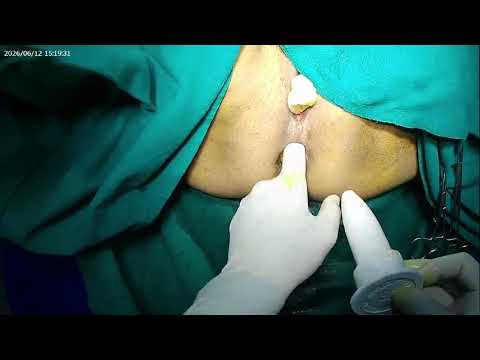
2.5 Post-Operative Course
Packing removal: Anal packing was removed at 5:00 a.m., approximately 14 hours following completion of surgery.
Day 2 post-operatively: On clinical assessment on the second post-operative day, the patient demonstrated perfectly normal anal sphincter tone and voluntary anal control. Digital examination confirmed adequate anal canal calibre with resolution of the severe stenosis. No soiling, urgency, or incontinence was reported.
Wexner Continence Score: 0 out of 20 at all assessed time-points, confirming zero post-operative faecal incontinence — identical to the outcome of the first bilateral OPB–MOLIS case at this institution and consistent with the 333-case OPB–MOLIS series result of 0% incontinence.
2.6 Six-Week Follow-Up (28 July 2026)
The patient was reviewed six weeks after the index procedure. The associated fissure was partially healed, and the patient reported no pain during or after defaecation. Anal canal calibration with graduated dilators demonstrated progressive luminal gain, with painless passage of a 27 mm dilator at this visit. Continence assessment confirmed a Wexner Continence Score of 0/20, with full voluntary control of both flatus and faeces maintained.
This six-week outcome sustains the early post-operative findings and provides interval evidence that the luminal gain achieved by bilateral OPB–MOLIS is durable and progressive, with continence fully preserved throughout the follow-up interval.
3. Outcomes Summary
| Procedure | Bilateral OPB–MOLIS |
|---|---|
| Indication | Severe anal canal stenosis (little finger not admissible with ease) |
| Date of Surgery | 14 June 2026 |
| Packing Removed | 5:00 a.m., 14 hours post-operatively |
| Day 2 Sphincter Tone | Perfectly normal tone and voluntary control |
| Wexner Score (pre-op) | Recorded (see clinical notes) |
| Wexner Score (follow-up) | 0/20 — Zero post-operative faecal incontinence (Day 2 and reconfirmed at 6-week follow-up) |
| 6-Week Follow-Up (28 Jul 2026) | Fissure partially healed; pain-free defaecation; painless dilator calibration to 27 mm; Wexner 0/20 with full flatus and faecal control |
| Result | 100% success — Stenosis resolved; continence preserved |
| Case Number | Second bilateral OPB–MOLIS case at Dr. Bhandari Piles Hospital |
4. Discussion
Severe anal canal stenosis presents a surgical dilemma: adequate decompression of the anal canal requires substantial division of the sphincter complex, yet aggressive sphincterotomy carries a well-recognised risk of post-operative faecal incontinence. Numerous approaches have been described, including anoplasty, advancement flaps, and staged sphincterotomy, but outcomes remain variable and incontinence rates are non-trivial in the published literature.
The OPB–MOLIS technique addresses this dilemma by limiting sphincterotomy to the lower one-third of the internal anal sphincter on anatomical grounds: this segment contributes to resting anal tone but, when isolated in its division, does not compromise the critical high-pressure zone of the upper sphincter complex required for maintaining continence. The 333-case primary series (2016–2025) confirms this principle, having achieved 0% incontinence across a decade of follow-up with Wexner Scoring.
The bilateral application of OPB–MOLIS extends this principle to severe stenosis, where a symmetric bilateral division is biomechanically superior to a single-sided approach: it distributes the circumferential stretch of the anal canal evenly, reducing risk of mucosal tears while achieving the necessary luminal expansion. The current patient’s recovery trajectory — normal sphincter tone and voluntary control already documented on the second post-operative day, and sustained with progressive luminal gain (painless calibration to 27 mm) and continued full continence at six-week follow-up — is consistent with the physiological preservation expected from the lower-third restriction.
The technique is notable for several reasons: (1) it is an open procedure under direct vision, avoiding the risks of inadvertent excessive division inherent to the closed technique; (2) bilateral application in severe stenosis is novel and reproducible in this surgeon’s hands; (3) the video documentation of the operative procedure provides an educational resource for colorectal surgeons seeking to adopt the technique.
This represents the second documented case of bilateral OPB–MOLIS performed at Dr. Bhandari Piles Hospital. Both cases yielded identical outcomes of zero incontinence and restored anal canal calibre. A prospective case series with standardised follow-up and validated continence scoring is warranted to further establish this technique in the surgical literature.
5. Conclusion
Bilateral OPB–MOLIS — Modified Open Lateral Internal Sphincterotomy with division of the lower one-third of the internal anal sphincter on both sides — is a technically feasible, safe, and effective surgical innovation for severe anal canal stenosis. In this 78-year-old female patient, the procedure delivered:
- Complete resolution of severe anal canal stenosis
- Perfectly normal sphincter tone and voluntary anal control by the second post-operative day
- Wexner Continence Score of 0/20 — 100% continence preservation
- No peri-operative complications
These outcomes reinforce the validity of the OPB–MOLIS principle across its applications — primary fissure-in-ano, contralateral salvage for recurrent fissure, and now bilateral use for severe anal stenosis — and support further multi-centre prospective evaluation of this innovation in colorectal surgery.
Declarations
- Ethics and Patient Consent
- Informed written consent was obtained from the patient for the surgical procedure and for publication of clinical details and operative video documentation. Patient anonymisation has been applied in this report.
- Conflict of Interest
- None declared.
- Funding
- No external funding was received for this case or this publication.
- Operative Video
- Operative video documentation of Bilateral OPB–MOLIS (Case: Rabiya, 78 years) is available on the institutional surgical education channel: Bilateral MOLIS for Severe Anal Canal Stenosis — Rabiya.
- Surgeon’s Web Presence
- Dr. Bhandari Piles Hospital, Chittorgarh · Surgeon Biography — Dr. O. P. Bhandari
References
- Bhandari OP. OPB-MOLIS — Modified Open Lateral Internal Sphincterotomy: Division of the Lower One-Third of the Internal Anal Sphincter — Ten-Year, 333-Case Single-Surgeon Series with Zero Post-Operative Faecal Incontinence. [Manuscript under review]. Dr. Bhandari Piles Hospital, Chittorgarh; 2026.
- Parks AG. The surgical treatment of haemorrhoids. Br J Surg. 1956;43(180):337–351.
- Jorge JM, Wexner SD. Etiology and management of fecal incontinence. Dis Colon Rectum. 1993;36(1):77–97.
- Milsom JW, Mazier WP. Classification and management of postsurgical anal stenosis. Surg Gynecol Obstet. 1986;163(1):60–64.
- Altomare DF, Rinaldi M, Milito G, et al. Sphincteroplasty for fecal incontinence in the elderly: does ageing affect the outcome? Dis Colon Rectum. 2004;47(6):912–918.
- Farouk R, Duthie GS, MacGregor AB, Bartolo DC. Rectoanal inhibition and incontinence in patients with rectal prolapse. Br J Surg. 1994;81(5):743–746.
- Bhandari OP. Bilateral OPB-MOLIS for Severe Anal Canal Stenosis: First Case Report. [Institutional Record]. Dr. Bhandari Piles Hospital, Chittorgarh; 2025.